2 · Quantum many-body spin systems with dense matrices
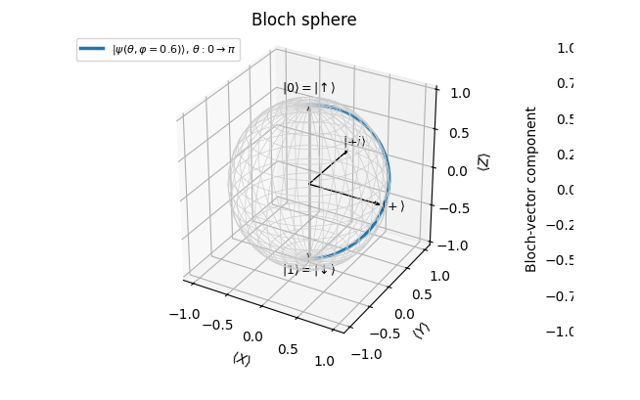
A chain of \(N\) spins-1/2 is put on the computer the way textbooks do it. Operators acting on one spin are lifted to the full \(2^N\)-dimensional space with Kronecker products, model Hamiltonians (transverse-field Ising, Heisenberg) are assembled as matrices, and their ground states and spectra follow from exact diagonalisation, which already shows the finite-size precursor of the quantum phase transition of the Ising chain.
The second notebook solves the time-dependent Schrödinger equation with the same dense matrices: the exact propagator, the explicit Euler and Runge–Kutta integrators and their stability, and Trotterization with its error measured, applied to a quench of the Ising chain. Both notebooks end at the same place, the memory and time cost of a \(2^N\times 2^N\) matrix, which is the reason for the matrix-free approach of Chapter 3. Prerequisites are notebooks 01 (JAX) and 02 (einsum and reshape) of Chapter 1, and notebook 04 uses the dense Hamiltonians and exact diagonalisation of notebook 03.
Notebooks in this chapter
Quantum many-body spin systems — the textbook (dense-matrix) way
From one spin-1/2 to interacting spin chains: tensor products, Kronecker-product operators, model Hamiltonians, exact diagonalisation of the transverse-field Ising and Heisenberg chains, and the exponential wall.
Time evolution with dense matrices — propagators, ODE solvers and Trotterization
Solving the many-body Schrödinger equation with dense matrices: exact propagators, why Euler fails and what RK4 does, Trotterization with measured error scaling, a transverse-field Ising quench, and the cost wall that motivates matrix-free methods.