11 · Quantum phase transitions
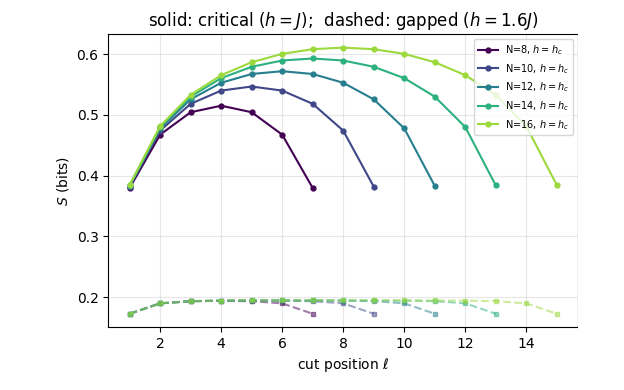
A quantum phase transition occurs in the ground state as a parameter of the Hamiltonian is varied. The notebook uses the transverse-field Ising chain, which has an exact solution, as a benchmark and locates its transition with four independent signatures: the order parameter, the energy gap, the entanglement entropy with its central charge, and the fidelity susceptibility. Finite-size scaling and data collapse turn results on finite chains into statements about the thermodynamic limit. DMRG carries the same analysis to 128 spins, and the XXZ chain adds a second universality class and a Kosterlitz-Thouless transition that finite-size scaling cannot pin down.
Prerequisites are the restarted Lanczos solver and symmetry sectors of notebook 11 in Chapter 5, whose Section 11 takes a first look at the same transition, and the Jordan-Wigner mapping to free fermions quoted in notebook 15 of the same chapter; entanglement entropy from Schmidt values, notebook 06 in Chapter 3; matrix product states and DMRG, notebook 18 in Chapter 7; and jax.jit from notebook 01 in Chapter 1. One remark relates the fidelity susceptibility to the quantum Fisher information of notebook 29 in Chapter 10.
Notebooks in this chapter
Quantum phase transitions — mapping a phase diagram from finite chains
How a ground-state phase transition is located numerically: the transverse-field Ising chain as a benchmark with an exact solution, four independent signatures of the same transition (order parameter, gap, entanglement entropy and central charge, fidelity susceptibility), finite-size scaling and data collapse, a second universality class from free fermions, and a Kosterlitz-Thouless transition that finite-size scaling cannot pin down.