9 · Entanglement and complexity diagnostics
This chapter collects diagnostics that characterise a quantum state beyond its energy and local observables. Entanglement negativity, computed from the partial transpose of the density tensor, detects entanglement in mixed states. Many-body Bell correlators extend the CHSH test to \(N\) parties: a single number certifies correlations that no local hidden-variable model reproduces and bounds how many parties share the entanglement, up to all \(N\).
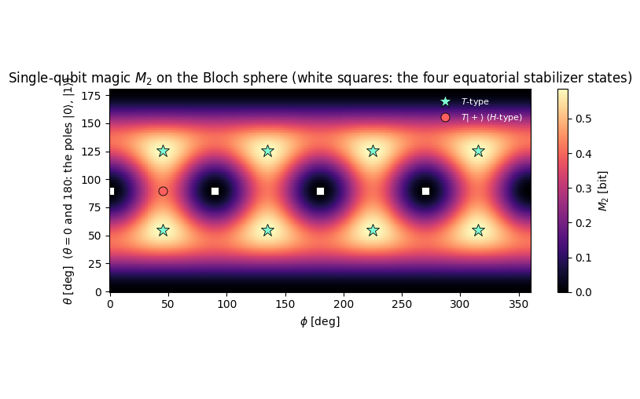
The stabilizer Rényi entropy measures non-stabilizerness (“magic”), the resource that separates classically simulable Clifford circuits from universal ones, and the final notebook combines entanglement, magic and spectral statistics to discuss how random circuits generate states that are hard to simulate.
Read notebook 25 first; it introduces the partial transpose and the PPT criterion. Notebook 48 covers the same criterion more briefly and adds the matrix-product-state route, for which it needs notebook 18 of Chapter 7. Notebook 26 can follow notebook 25 directly. Notebook 27 does not depend on notebooks 25 and 26, and notebook 28 builds on notebook 27. Prerequisites are notebooks 01 and 02 of Chapter 1; the matrix-free gate application of notebook 05, for notebook 27, and the reduced density matrices, density tensors and channels of notebooks 06 and 07 in Chapter 3; the gates, the Clifford group and the random circuits of notebooks 09 and 10 in Chapter 4, for notebooks 27 and 28; Lanczos, TEBD and the light cone after a quench, notebooks 11, 12 and 15 in Chapter 5; the quantum trajectories of notebook 17 in Chapter 6, for the noisy Bell correlator; and CHSH, Werner states and GHZ decoherence from notebooks 19, 21 and 22 in Chapter 8. Notebook 26 also uses material from later chapters: Adam and SPSA from notebook 41 of Chapter 13 in its Section 7, and one-axis twisting from notebooks 33 and 34 of Chapter 10 in its Section 11. Magic returns in notebook 37 of Chapter 10, as a property of the probe states used in metrology.
Notebooks in this chapter
Entanglement of mixed states: separability, the partial transpose as an axis swap of the density tensor, the PPT criterion, negativity and logarithmic negativity, Werner and noisy GHZ thresholds, the pure-state Schmidt formula, block negativity in the transverse-field Ising ground state, and entanglement sudden death.
From CHSH to N parties: the many-body Bell correlator built from local lowering operators, its local-realistic and separability bounds, matrix-free evaluation with einsum, optimisation of the measurement directions with jax.grad and SPSA, noise sweeps on the density tensor and on quantum trajectories with a bias-corrected estimator, and the correlator along a one-axis-twisting evolution.
Stabilizer Renyi entropy: measuring the magic of a quantum state
Non-stabilizerness (“magic”) as the resource that entanglement misses: the Pauli group and the symplectic product, stabilizer states and the Gottesman-Knill theorem, the characteristic Pauli distribution, stabilizer Renyi entropies with proofs of their properties, the brute-force \(4^N\) algorithm and the fast Walsh–Hadamard algorithm, and magic in T-doped circuits, in Ising ground states and after a quench.
Quantum circuit complexity — entanglement, magic and spectral statistics of random circuits
What makes a quantum state hard to simulate classically, and how circuits build that hardness: entanglement and the Page value, non-stabilizerness, the entanglement spectrum (flat for stabilizer states, Marchenko-Pastur for random states), its level statistics, output anticoncentration, and why all of these are only proxies for circuit complexity proper.
Quantifying entanglement of quantum states
Pure-state entanglement and why the Schmidt spectrum is the whole story; the zoo classified (GHZ has no pairwise entanglement, W does); why mixed states are harder; the partial transpose as one axis swap; the PPT criterion and negativity, calibrated on Werner states; entanglement death under noise; negativity, mutual information and pair entropy against distance in the XXZ chain; the same two measures from a matrix product state, with mps_rdm2 derived leg by leg and validated against exact diagonalisation.