5 · Ground states and unitary dynamics
Each method of this chapter has its own notebook. Spin Hamiltonians on arbitrary graphs are written as lists of local terms, and the Lanczos algorithm, derived from the power method, delivers their ground states without building a matrix; symmetry sectors give the gap, and the Ising and XXZ chains, a \(4\times4\) lattice and long-range couplings serve as physics examples. Three propagators follow: Trotter–Suzuki splitting with two-site gates (orders one, two and four), the Chebyshev expansion of the propagator, and Krylov-subspace exponentiation with an a-posteriori error bound. Each is derived, implemented with jit and lax.scan, and validated against exact evolution.
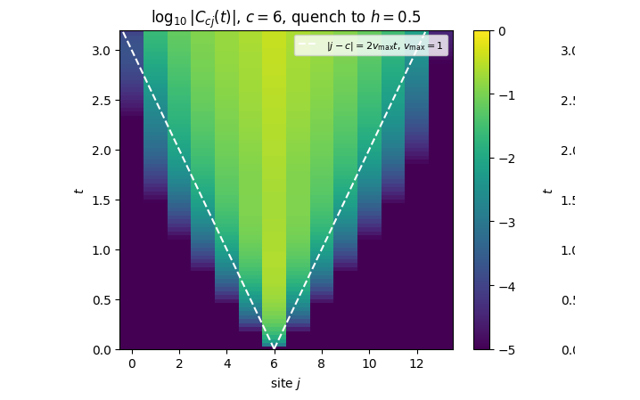
A head-to-head benchmark compares the integrators on accuracy and cost, uses the Loschmidt echo as a sensitive test, and ends with a table for choosing an integrator. The final notebook uses them for the physics of quantum quenches in spin chains: relaxation of the magnetisation, light cones, domain-wall melting, entanglement growth, integrable versus non-integrable chains and the Loschmidt echo with its dynamical phase transitions.
Read the notebooks in the listed order. Notebook 12 takes the Ising and XXZ models and their symmetries from notebook 11; notebook 13 uses the Lanczos iteration of notebook 11 for its spectral bounds and compares against notebook 12; notebook 14 builds on the Lanczos iteration of notebook 11 and compares against notebooks 12 and 13; notebook 15 uses mainly the Trotter–Suzuki evolution of notebook 12 and needs the other two integrators only as cross-checks, so a reader interested in the physics can go from 12 to 15 directly.
Prerequisites are notebook 01 (JAX: jit, vmap, lax.scan) of Chapter 1, the models, dense diagonalisation and textbook time evolution of notebooks 03 and 04 in Chapter 2, and Chapter 3: apply_gate and apply_hamiltonian of notebook 05 and the reduced density matrices, Schmidt decomposition, entanglement entropy and Page value of notebook 06. The Trotter circuit of notebook 09 in Chapter 4 is the gate sequence of notebook 12. Open systems follow in Chapter 6, and the same Trotter gates act on matrix product states in Chapter 7.
Notebooks in this chapter
Hamiltonians and ground states — from the power method to Lanczos
Spin Hamiltonians on arbitrary graphs as lists of local terms, the matrix-free product H|ψ⟩, and the Lanczos algorithm derived from the power method: Ritz values, loss of orthogonality, symmetry sectors, and the ground-state physics of the Ising and XXZ models up to N = 18–20 spins.
Time evolution I — TEBD: Trotter–Suzuki evolution of a state vector
Matrix-free Trotter–Suzuki (TEBD) time evolution with two-site gates applied by einsum: derivation of the 1st, 2nd and 4th order formulas, measured local and global error scaling, conserved quantities as diagnostics, gate fusion, and a jit + lax.scan implementation validated against exact evolution and free fermions.
Time evolution II — Chebyshev propagation
The Chebyshev (Tal-Ezer–Kosloff) expansion of the propagator: Chebyshev polynomials, Bessel coefficients, the Jacobi–Anger identity, spectral rescaling, a lax.scan implementation accurate to machine precision, and its cost compared with TEBD.
Time evolution III — Krylov propagation and the integrator shoot-out
Krylov-subspace (Lanczos) exponentiation derived and validated, with a rigorous a-posteriori error bound and adaptive steps; then a measured head-to-head benchmark of exact, TEBD (orders 1, 2, 4), Chebyshev and Krylov integrators and a practical guide to choosing among them.
Quench dynamics in spin chains — light cones, entanglement growth, relaxation
The time-evolution toolbox applied to quantum quenches in XXZ, Heisenberg and transverse-field Ising chains — relaxation of magnetisation, Lieb–Robinson light cones, domain-wall melting, entanglement growth, integrable versus non-integrable behaviour and the Loschmidt echo.