6 · Open quantum systems
A quantum system coupled to an environment is described by a density matrix that obeys the Gorini–Kossakowski–Sudarshan–Lindblad master equation. The first notebook introduces jump operators, applies the Lindbladian matrix-free to the rank-\(2N\) density tensor, compares Runge–Kutta and Trotter–Kraus time stepping, and checks the results against analytic single-qubit solutions before moving to a dissipative spin chain. With \(\sigma^\pm=(X\pm iY)/2\) and \(|0\rangle\) the \(+1\) eigenstate of \(Z\), decay of the excited level \(|1\rangle\) to \(|0\rangle\) has the jump operator \(\sigma^+=|0\rangle\langle1|\); quantum-optics texts call the same operator \(\sigma^-\).
The second notebook unravels the same dynamics into pure-state quantum trajectories with random quantum jumps, proves that their average obeys the Lindblad equation, and uses vmap over trajectories to reach system sizes for which the density tensor no longer fits in memory, up to dephasing-induced diffusion in a chain of 16 spins.
Read notebook 16 before notebook 17. The density tensor (\(4^N\) numbers) gives averages without statistical error and is the method of choice up to about ten spins; trajectories (\(2^N\) numbers each, with a statistical error \(\propto1/\sqrt M\) for \(M\) trajectories) take over beyond, and they are the only route above about 13 spins, where the density tensor and its Runge–Kutta copies no longer fit into the memory of a laptop. Prerequisites are notebook 01 (jit, vmap, lax.scan, random keys) of Chapter 1; apply_gate, partial traces, density matrices, Kraus channels and their stochastic unravelling, notebooks 05 to 07 in Chapter 3; and the Trotter–Suzuki gates of notebook 12 and, for the last section of notebook 17, the domain-wall quench of notebook 15 in Chapter 5. Long chains with little entanglement follow in Chapter 7, with matrix product states.
Notebooks in this chapter
Open quantum systems I — the Lindblad master equation on a density tensor
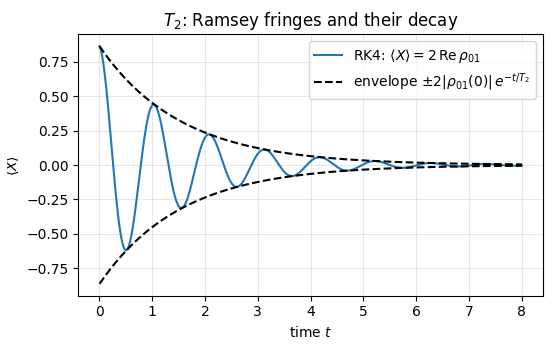
The GKSL master equation for newcomers: jump operators, a matrix-free Lindbladian acting on the rank-2N density tensor, RK4 versus Trotter–Kraus time stepping, analytic single-qubit checks (T1, T2, driven-dissipative steady state) and a dissipative spin chain.
Open quantum systems II — quantum trajectories (Monte-Carlo wave function)
Quantum trajectories: effective non-Hermitian Hamiltonian, quantum jumps, proof that the ensemble average obeys the Lindblad equation, scan-over-time and vmap-over-trajectories implementation, \(1/\sqrt M\) error bars, the \(2\times2\) comparison density matrix vs trajectories and RK4 vs Trotter, and a 16-spin open chain that no density matrix could hold.