10 · Quantum metrology protocols
Quantum metrology asks how precisely a parameter imprinted on a quantum state can be estimated. The chapter follows one path through the subject.
Foundations. Notebook 29 builds estimation theory from a classical meter up to the quantum Fisher information, the quantum Cramér–Rao bound, and the two limits it sets: the standard quantum limit for independent particles and the Heisenberg limit for entangled ones. Notebook 30 evaluates the quantum Fisher information of mixed states through the symmetric logarithmic derivative and runs the protocol prepare–encode–measure–estimate end to end.
Protocols. Ramsey interferometry at the standard quantum limit (31), GHZ interferometry at the Heisenberg limit (32), spin squeezing by one-axis twisting (33), and the same twisting continued to a GHZ-like cat, with its readouts and its fragility under noise (34).
Practical limits. Notebook 37 asks how much quantum Fisher information survives particle loss and how encoded probes protect it.
Measuring the quantum Fisher information. Notebook 36 estimates it for a prepared state from randomised measurements (classical shadows) and counts the measurements an entanglement certificate needs.
Many-body dynamics. Notebook 39 follows how metrologically useful entanglement grows and spreads in quenched spin chains.
Variational optimisation. Notebook 44b in Chapter 13 optimises probe states and measurements under noise with automatic differentiation.
Read notebooks 29 to 34 in order; they form the main thread, and every later notebook uses notebooks 29 and 30. Notebooks 36, 37 and 39 are closer to current research and can be read selectively: they rest on notebooks 29 and 30 and take the states of notebooks 33 and 34 only as examples. Prerequisites are notebooks 01 and 02 of Chapter 1; the state tensors, reduced density matrices, channels and measurements of notebooks 05 to 08 in Chapter 3; the gates and Haar-random unitaries of notebooks 09 and 10 in Chapter 4; in Chapter 5, the Lanczos ground-state solver of notebook 11 for the Ising ground states of notebook 29, and TEBD and quench dynamics, notebooks 12 and 15, for notebook 39; in Chapter 8, the GHZ states of notebook 22 for notebooks 29 and 32, and the classical shadows of notebook 24 for notebooks 32 and 36; and the stabilizer Rényi entropy and the Gottesman–Knill theorem of notebook 27 in Chapter 9, for notebook 37.
Notebooks in this chapter
Quantum Fisher information — how fast a quantum state changes under a small parameter shift
Parameter estimation and its quantum limit: estimators, score and classical Fisher information, the Cramér–Rao bound derived by Cauchy–Schwarz, the symmetric logarithmic derivative and the Braunstein–Caves inequality, the pure-state reduction \(F_Q=4\,\mathrm{Var}(G)\) and the speed of a state, error propagation, product state versus GHZ (standard quantum limit and Heisenberg limit) and the fragility of the GHZ advantage, including superdecoherence, a zoo of many-body states, the \(3\times3\) collective QFI matrix and its optimal direction, QFI as an entanglement witness, and QFI under noise and particle loss.
QFI from the symmetric logarithmic derivative — prepare, encode, estimate
The complete metrology pipeline for mixed states: encode a parameter unitarily on a density tensor, get the derivative three ways (commutator, finite differences, jax.jacfwd), solve the Lyapunov equation for the symmetric logarithmic derivative, evaluate the quantum Fisher information and cross-check it against 4 Var(G), the engine, and the Bures fidelity susceptibility, build the optimal measurement from the eigenbasis of the SLD and verify by simulated maximum-likelihood experiments that it saturates the quantum Cramér–Rao bound while a convenient fixed readout does not, with the finite-sample bias of the estimator predicted and measured.
Ramsey interferometry — the standard quantum limit, simulated end to end
The complete Ramsey protocol of an atomic clock — coherent spin state, phase encoding, second pulse, atom counting — with the signal and the projection noise derived, phase estimators built from sampled bit strings, the measured sensitivity checked against the Cramér–Rao bound, and dephasing during the interrogation fixing the optimal interrogation time.
GHZ interferometry and the Heisenberg limit — gain, ambiguity, fragility
The maximally entangled interferometer end to end: GHZ preparation, N-fold phase encoding, parity readout, phase estimation from sampled records reaching \(\Delta\varphi=1/N\), the \(2\pi/N\) ambiguity, the collapse of the advantage under dephasing, depolarising, damping and particle loss, the Huelga argument that Markovian dephasing removes the asymptotic gain, and phase estimation from randomised measurements after scrambling.
Spin squeezing by one-axis twisting
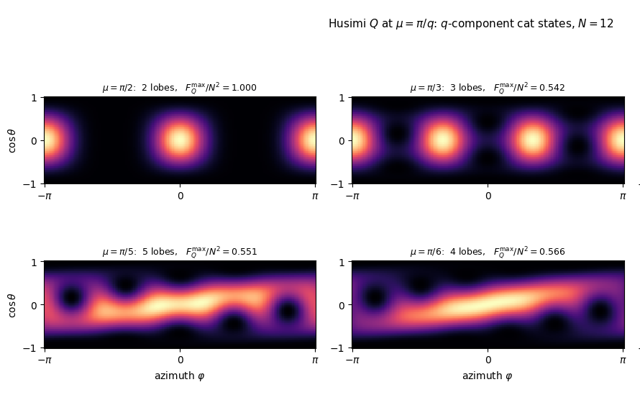
Coherent spin states and their isotropic projection noise, the one-axis-twisting Hamiltonian and its two exact implementations, the shearing mechanism, the Kitagawa–Ueda and Wineland squeezing parameters derived from Ramsey error propagation, the analytic OAT moments verified numerically, the \(N^{-2/3}\) scaling of the optimal squeezing, a squeezed Ramsey interferometer simulated end to end from sampled bit strings, Husimi-Q maps on the Bloch sphere, and the point where squeezing stops measuring the metrological gain.
From one-axis twisting to GHZ — the full metrology protocol
The complete pipeline prepare-twist-encode-read out: the exact derivation that one-axis twisting turns a coherent spin state into a GHZ-like cat at \(\chi t=\pi/2\) (for even and for odd \(N\)), the cat axis tracked numerically with the \(3\times3\) QFI matrix along the whole evolution, the \(N^2/2\) plateau of the multi-component cats, parity readout reaching the Heisenberg limit from sampled data, the SLD quantum Fisher information under dephasing, amplitude damping and depolarising noise, the exponential fragility of the cat derived and verified, the optimal stopping time under noise, and a final comparison of the sensitivity of Ramsey, squeezed, GHZ and one-axis-twisting interferometry.
Measuring the quantum Fisher information with classical shadows
How the quantum Fisher information of a collective generator is estimated from one randomised-measurement data set: the expansion of \(4\,\mathrm{Var}(G)\) in one- and two-body Pauli expectation values, the \(O(N^2)\) observable count, a collapse of the estimator to six numbers per snapshot, the exact bias of the plug-in estimator and its U-statistic correction, bootstrap error bars and their scaling with the number of snapshots and the system size, the \(3\times3\) matrix and the optimal direction from data, the snapshot budget needed to certify entanglement and entanglement depth, and what happens for mixed states — the gap between \(4\,\mathrm{Var}(G)\) and the true quantum Fisher information, and a converging series of polynomial lower bounds that randomised measurements can reach.
Particle loss, magic and encoded probes — the quantum Fisher information of the survivors
How much metrological usefulness survives the loss of k particles: the quantum Fisher information of a reduced state derived and computed three ways, exact loss laws for product, GHZ, W and Dicke probes, the loss budget of squeezed and random probes, the stabilizer Rényi entropy of every probe family, and phase-imprinted GHZ states protected by a Clifford erasure code — an all-or-nothing loss threshold explained by logical operators, its dependence on which qubits are lost, its trade-off against sensitivity to a local generator, and what magic changes about it.
The spreading of metrological usefulness — quantum Fisher information in quenched spin chains
How useful entanglement is built and transported by a spin chain: the exact identity between the quantum Fisher information and the connected correlations, the QFI density and the certified entanglement depth after global quenches of the transverse-field Ising and XXZ chains, uniform against staggered generators, and the light cone of the block-resolved and two-site QFI after a local encoding — with a one-magnon closed form as the analytic anchor, a measured front velocity and its derived threshold dependence, a magnon trapped at the chain end, and a bound magnon pair carrying the resource at the speed 2/Δ, animated.