1 · Mathematical Foundations
Every later part averages some function of a random unitary, and to state what is being averaged one needs density matrices for the states, completely positive maps for the noisy evolutions, and a precise meaning for the word random. This part assembles that vocabulary from elementary pieces. The Lie algebras \(\mathfrak{u}(D)\) and \(\mathfrak{su}(D)\) are built from commutators and the matrix exponential, the geometry of pure states from the Fubini-Study metric, and the notion of a uniform distribution on \(U(D)\) from enough measure theory to make \(\sigma\)-additivity and measurability concrete. No prior exposure to Lie groups is assumed.
Two constructions do most of the later work. The Choi-Jamiołkowski isomorphism turns a quantum channel into a state on a doubled Hilbert space, converting questions about maps into questions about matrices. Schur-Weyl duality identifies the operators that commute with \(U^{\otimes k}\) for every \(U\) with the algebra generated by permutations of the \(k\) copies, which is why Haar averages over many entries collapse onto a small number of permutation terms. The notebooks work the \(k=2\) case in full, where the only operators in play are the identity and the SWAP.
One point deserves early emphasis. Closing a set of generators under repeated commutators produces the dynamical Lie algebra, and whether that algebra fills out all of \(\mathfrak{su}(D)\) or stays inside a subalgebra decides both whether a gate set is universal and how fast an operator can grow under the dynamics of later chapters.
Notebooks in this part
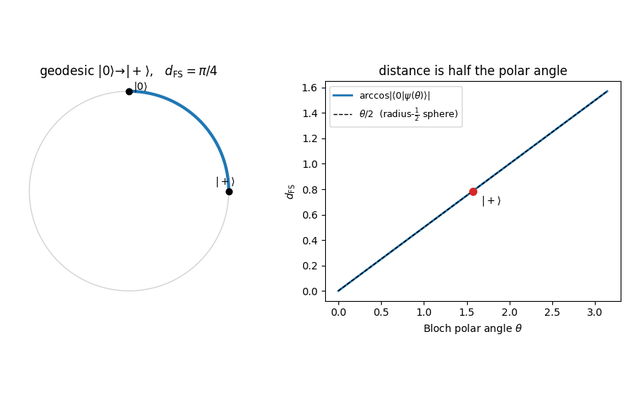
Bloch-sphere geodesics & the Fubini-Study metric
The natural distance between pure states.
Entanglement of a parametric two-qubit state
How entanglement tracks a tunable coupling.
Kraus operators, complete positivity, and entanglement fidelity.
Dynamical Lie algebra of a three-qubit Ising chain
Building an algebra by repeated commutators, and why parity alone does not explain its fifteen dimensions.
Schur-Weyl duality for \(k=2\)
The symmetric/antisymmetric split and the SWAP operator.
Choi matrix of amplitude damping
Channels as states via Choi-Jamiołkowski.
Unitaries that commute with a Hamiltonian
Counting the commutant: a torus for a non-degenerate spectrum, \(\sum_k d_k^2\) dimensions with degeneracies.
Surjectivity of the exponential map
Why every unitary is an exponential.
What “uniformly random unitary” means, in the simplest case.
Geodesic length & the quantum speed limit
How fast a state can change.
Sectional curvature on \(SU(3)\)
Planes of curvature \(0\), \(\tfrac12\) and \(\tfrac18\), and which nearby evolutions reconverge fastest.
Differential geometry of state space
The quantum geometric tensor, Berry curvature, and the Fubini-Study metric together.
Lebesgue vs counting measure and \(\sigma\)-additivity.
Borel \(\sigma\)-algebras & measurability on \(U(D)\)
Making “random” rigorous.
Where to start. If you only want the tools used later, do Schur-Weyl duality, Haar invariance, and the depolarizing channel first, everything in Part 3 builds directly on them.