3 · Haar Measure & Weingarten Calculus
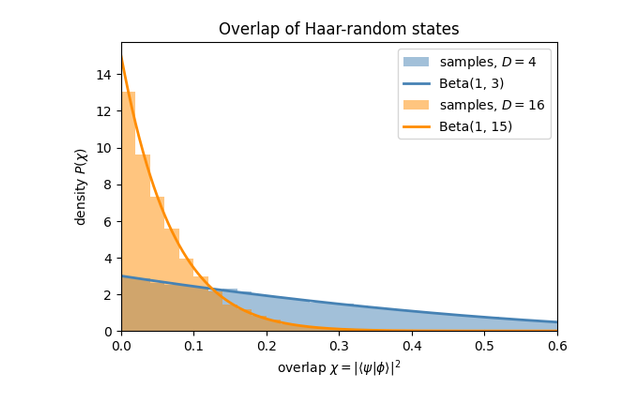
Most of the quantitative statements in this subject are averages over the unitary group. One asks for the mean of a polynomial in the entries of a random unitary, the entanglement of a state prepared by a random circuit, the variance of a cost-function gradient, the fidelity that survives a noisy gate. In each case the hard-looking object is a low moment of the Haar measure, the unique distribution on \(U(d)\) invariant under left and right multiplication. The Weingarten calculus is what turns these averages into arithmetic.
The mechanism rests on one representation-theoretic fact. Averaging \(k\) copies of \(U\) produces an operator that commutes with \(U^{\otimes k}\) for every \(U\), so it lies in the commutant of the \(k\)-fold representation. Schur-Weyl duality identifies that commutant with the algebra generated by permutations of the \(k\) tensor factors. An integral over a continuous group therefore collapses to a finite sum over the symmetric group \(S_k\), with coefficients supplied by the Weingarten function. For the second moment the only permutations are the identity and the swap, and a surprising amount of the later material follows from that single case.
Three consequences are worth isolating before the notebooks. The first moment is a twirl, sending any operator to its normalized trace times the identity, which is the precise sense in which a uniformly random rotation erases everything but the trace. The second moment produces purities, frame potentials, and the Page formula for the entanglement of a typical pure state. Concentration of measure then upgrades these averages from typical to overwhelming, so that in high dimension a single random state already behaves like the whole ensemble. The factor \(1/d\) that fixes the mean purity is the same one that reappears later as the variance of a barren-plateau gradient, which is the thread running from this part to quantum machine learning.
Notebooks in this part
The first Haar moment (twirling)
Averaging an operator to its normalized trace times the identity.
Turning purity into a two-copy expectation value.
The distribution of \(|\langle\psi|\phi\rangle|^2\) and its moments.
A warm-up: \(\mathbb{E}|\mathrm{Tr}\,U|^4 = 2\).
Weingarten calculus as tensor networks
Diagrammatic contractions, including the third trace moment.
Average entanglement of a random state, via Marchenko-Pastur.
Why a random subsystem is almost exactly maximally mixed.
The single most reused result in this tutorial is the second-moment twirl \(\mathbb{E}_U[U^{\otimes 2}\,X\,U^{\dagger\otimes 2}] = c_{\mathbb{I}}\,\mathbb{I} + c_{\mathbb{F}}\,\mathbb{F}\). If you internalize one calculation, make it this one.