5 · Designs & Clifford Ensembles
A Haar-random unitary on \(N\) qubits needs exponentially many real parameters to specify and cannot be sampled or stored efficiently. Most calculations, however, touch the Haar measure only through its low moments, the averages of \(U^{\otimes t} \otimes \bar U^{\otimes t}\). A unitary \(t\)-design is a finite ensemble that reproduces those averages up to order \(t\), which is all the randomness the second-moment and fourth-moment formulas of Parts 3 and 6 actually consume.
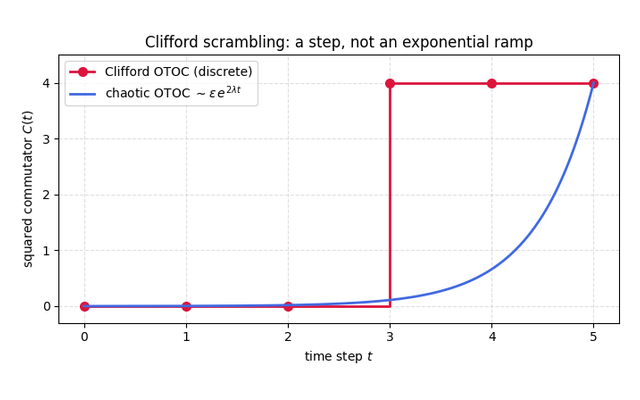
The Clifford group is the standard construction. It is an exact \(3\)-design and, by the Gottesman-Knill theorem, can be sampled and simulated classically in polynomial time. That same simulability marks what a design leaves out. Clifford circuits reach near-maximal entanglement, yet their out-of-time-ordered correlator takes only the values \(0\) and \(4\), with no smooth Lyapunov growth, so entanglement and genuine scrambling come apart here.
The missing resource is nonstabilizerness, or magic, the degree to which a state lies outside the set reachable by Clifford operations on computational basis states. The stabilizer Rényi entropy quantifies it from the expansion of the state over Pauli operators, vanishing exactly on stabilizer states and positive otherwise, and it is the quantity that separates a \(3\)-design from full Haar randomness.
Notebooks in this part
Why Clifford circuits scramble but have no Lyapunov exponent (the OTOC is \(0\) or \(4\)).
Measuring “magic,” the resource beyond entanglement.