2 · Random Matrix Theory
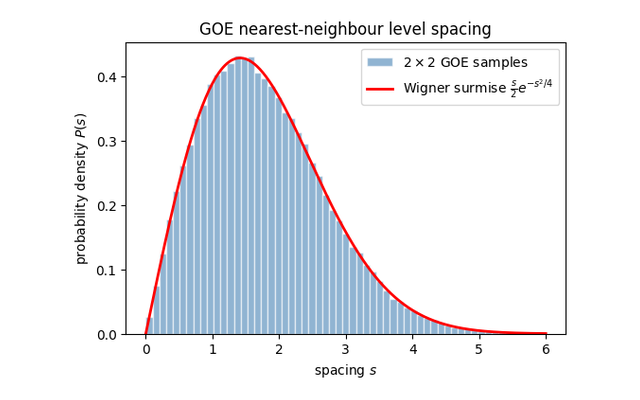
A quantum system with no integrable structure has energy levels that look erratic, yet their fine-grained statistics are reproducible. Across nuclei, quantum billiards, and disordered conductors, the spacing distribution of neighbouring levels matches that of a random matrix sharing the system’s symmetries, the content of the Bohigas-Giannoni-Schmit conjecture. Random matrix theory supplies the reference distributions and explains why they are universal.
The mechanism is level repulsion. Changing variables from matrix entries to eigenvalues produces a Jacobian carrying a factor of the squared eigenvalue differences, which suppresses configurations with near-degenerate levels. The power with which that factor vanishes is fixed by the time-reversal and spin-rotation symmetry of the ensemble, giving exponents \(1\), \(2\), and \(4\) for the orthogonal, unitary, and symplectic classes. This part derives the Wigner surmise from the two-by-two case, computes the semicircle density through its moments and the Catalan numbers that count them, and introduces the gap-ratio statistic that diagnoses chaos without the spectral unfolding that raw level spacings require.
One caution about the surmise. It is exact only for \(2\times2\) matrices; its accuracy at large dimension is an empirical near-coincidence rather than the true large-\(N\) spacing law. This is part of why the gap ratio, which is insensitive to the local mean level density, is often preferred in practice.
Notebooks in this part
Deriving the Wigner surmise for nearest-neighbour spacings.
Moments of the Wigner semicircle
The Catalan-number combinatorics behind the density.
Eigenphase repulsion in the CUE
The same physics for unitaries on the circle.
Unfolding a many-body spectrum
The mixed-field Ising chain end to end: symmetry sectors, the unfolding map, and the two ways the fit can fail.
Time reversal for two spins and in a field
A real basis when \(\hat T^2=+1\), Kramers degeneracy lifted by a field, and the gap ratio of a GSE spectrum with both partners kept.