Part (a): Deriving the metric
Step 1: Compute \(|d\psi\rangle\).
Differentiating the state:
\[
|d\psi\rangle = -\frac{1}{2}\sin\frac{\theta}{2}\,d\theta\,|0\rangle + e^{i\varphi}\left[\frac{1}{2}\cos\frac{\theta}{2}\,d\theta + i\sin\frac{\theta}{2}\,d\varphi\right]|1\rangle.
\]
Step 2: Compute \(\langle d\psi|d\psi\rangle\) (Term 1).
The squared norm gives three contributions:
\[
\langle d\psi|d\psi\rangle = \frac{1}{4}\sin^2\frac{\theta}{2}\,d\theta^2 + \frac{1}{4}\cos^2\frac{\theta}{2}\,d\theta^2 + \sin^2\frac{\theta}{2}\,d\varphi^2.
\]
Using \(\sin^2 + \cos^2 = 1\):
\[
\langle d\psi|d\psi\rangle = \frac{1}{4}d\theta^2 + \sin^2\frac{\theta}{2}\,d\varphi^2.
\]
Step 3: Compute \(|\langle\psi|d\psi\rangle|^2\) (Term 2).
The inner product \(\langle\psi|d\psi\rangle\) has two contributions:
- From \(d\theta\): \(\cos\frac{\theta}{2}\cdot(-\frac{1}{2}\sin\frac{\theta}{2}) + \sin\frac{\theta}{2}\cdot\frac{1}{2}\cos\frac{\theta}{2} = 0\). (The real part cancels!)
- From \(d\varphi\): \(\sin\frac{\theta}{2}\cdot i\sin\frac{\theta}{2} = i\sin^2\frac{\theta}{2}\,d\varphi\).
Therefore:
\[
|\langle\psi|d\psi\rangle|^2 = \sin^4\frac{\theta}{2}\,d\varphi^2.
\]
Step 4: Combine.
\[
ds^2_{\mathrm{FS}} = \frac{1}{4}d\theta^2 + \sin^2\frac{\theta}{2}\,d\varphi^2 - \sin^4\frac{\theta}{2}\,d\varphi^2 = \frac{1}{4}d\theta^2 + \sin^2\frac{\theta}{2}\cos^2\frac{\theta}{2}\,d\varphi^2.
\]
Using \(\sin^2\frac{\theta}{2}\cos^2\frac{\theta}{2} = \frac{1}{4}\sin^2\theta\):
\[
\boxed{ds^2_{\mathrm{FS}} = \frac{1}{4}\bigl(d\theta^2 + \sin^2\!\theta\,d\varphi^2\bigr).}
\]
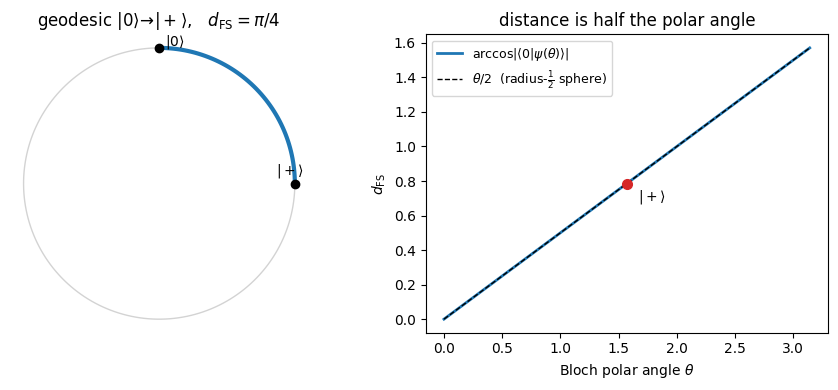
This is the metric of a round sphere of radius \(R = 1/2\). The Bloch sphere has half the radius of the “geographic” unit sphere, the factor \(1/2\) arises from the half-angle parametrization of \(\mathrm{SU}(2)\).
Part (b): Geodesic distance \(|0\rangle \to |+\rangle\)
The north pole is \(\theta = 0\) and \(|+\rangle\) is at \(\theta = \pi/2\), \(\varphi = 0\). Along the meridian (\(d\varphi = 0\)), the geodesic length is:
\[
d_{\mathrm{FS}} = \int_0^{\pi/2} \frac{1}{2}\,d\theta = \frac{\pi}{4}.
\]
Equivalently, using the closed-form Fubini-Study distance:
\[
d_{\mathrm{FS}}(|\psi\rangle, |\phi\rangle) = \arccos|\langle\psi|\phi\rangle|.
\]
\[
|\langle 0|+\rangle| = \frac{1}{\sqrt{2}}, \qquad d_{\mathrm{FS}} = \arccos\frac{1}{\sqrt{2}} = \frac{\pi}{4}. \quad \checkmark
\]