6 · Applications of Scrambling
In the earlier chapters randomness is something to characterize. Here it is deployed on purpose, because the same Haar second moment that fixes the Page curve also underwrites protocols for learning and benchmarking quantum systems and sharpens a thought experiment about black holes.
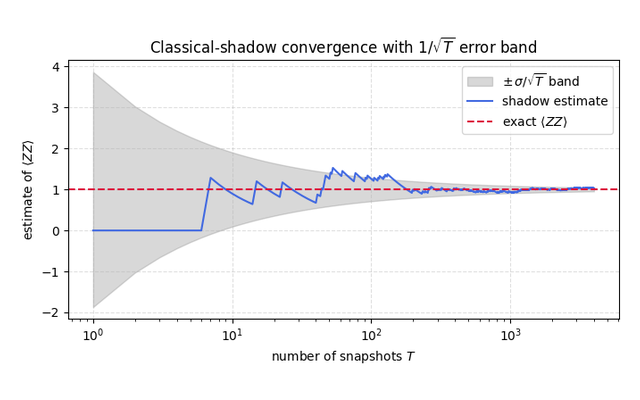
Classical shadows use random single-copy measurements followed by an analytic inversion of the measurement channel to predict many observables of an unknown state from few copies, with a sample cost controlled by a shadow norm that grows as \(3^k\) for \(k\)-local Pauli observables. Randomized benchmarking averages over random Clifford sequences so that gate-dependent noise twirls into a single depolarizing channel, whose strength is read from the exponential decay of the survival probability and reported as an average fidelity. Both rest on the same twirl, the second-moment average that replaces a complicated operator by a combination of the identity and the swap.
The Hayden-Preskill thought experiment applies that mathematics to a black hole modelled as a fast scrambler. Information dropped in can be reconstructed from the outgoing radiation almost as soon as it is absorbed, provided one already holds the radiation emitted earlier, a statement the decoupling theorem makes precise and which reuses the Page-curve estimate of Part 3. Tripartite mutual information turns the same average into a scrambling diagnostic, while the fragility of GHZ-state metrology shows the cost of storing information non-locally, where the loss of a single qubit erases a Heisenberg-scaling signal.
Notebooks in this part
Inverting the measurement channel, the heart of classical shadows.
Estimating observables from random measurements.
Extracting gate fidelity from an exponential decay.
A quantitative diagnostic of scrambling.
Heisenberg-scaling sensitivity destroyed by a single lost qubit.