7 · Quantum Machine Learning
A variational quantum circuit is trained by following the gradient of a cost function, which works only when that gradient is large enough to estimate from a realistic number of measurements. Once the circuit is expressive enough to form an approximate \(2\)-design over its parameters, the Haar second moment from Part 3 forces the variance of every gradient component to shrink exponentially in the qubit count. This is the barren plateau, where the landscape is flat to within sampling noise and gradient-based optimization has no direction to follow.
The same second-moment estimate identifies what restores a usable gradient. Local cost functions, restricted symmetry sectors, and shallow circuit blocks all keep the ensemble short of a full \(2\)-design and recover a variance that decays only polynomially. The plateau reappears under other names with one origin. Quantum kernel entries concentrate around a fixed value and lose the structure a kernel method relies on, the quantum Fisher information matrix flattens in the metrology reading of the same collapse, and generative and reservoir models, from Born machines to extreme learning machines and reservoir computers, push their output distributions toward Porter-Thomas statistics so that the informative signal concentrates away.
The operative tension is that scrambling supplies expressivity while removing trainability, so the workable regime is a structured ensemble that stops short of Haar randomness.
Notebooks in this part
Gradient variance vanishing exponentially with qubit number.
Local vs global cost functions
How observable locality rescues trainability.
Barren plateaus via quantum Fisher information
The metrology view of the same collapse.
Why over-expressive kernels become uninformative.
Concentration of a generative model’s output distribution.
Feature collapse in quantum extreme learning machines.
Injection contractivity and restarting overhead.
Worked examples
Five end-to-end examples where a fixed scrambling feature map extracts the features and only a linear readout is trained. Each one states where it works and where it breaks.
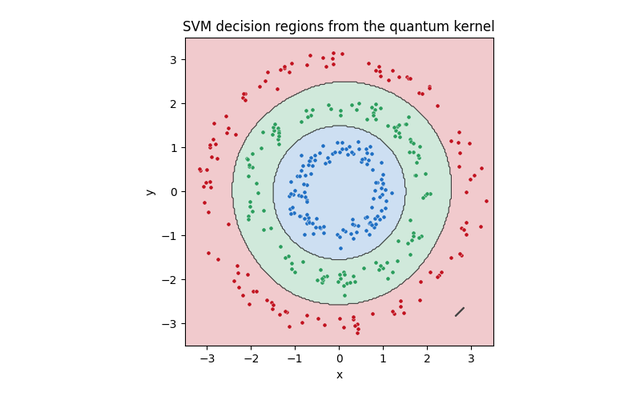
Quantum-kernel classification of concentric rings
A fidelity kernel and a soft-margin classifier, with the onset of kernel concentration.
A trained linear readout on a fixed reservoir, the data re-uploading Fourier ceiling and the over-scrambling downturn.
The minimal nonlinear-separation task and its ablation.
Ordinary transverse-field Ising order, where local observables already suffice.
QELM for a symmetry-protected phase
Discovering the nonlocal string order that distinguishes an SPT phase, where scrambling is essential.
Full circle. The exponential that obstructs training here is the same \(1/D\) from the Page formula in Part 3, typicality, viewed from the other side.