4 · Quantum Dynamics & Chaos
Random matrix theory characterizes a chaotic spectrum but says nothing about how information moves in time. This part follows an operator that starts local and asks how it spreads across the system, the process called scrambling, and collects the diagnostics that detect it.
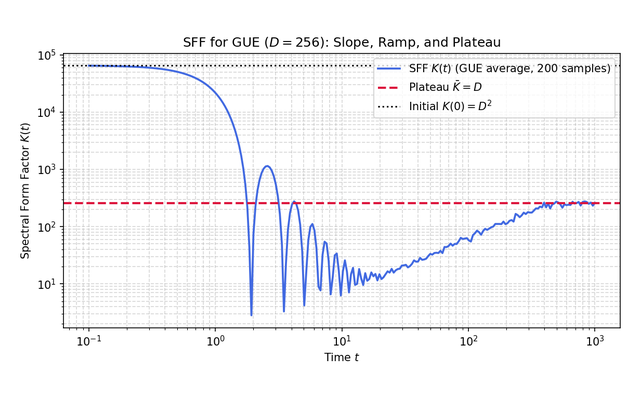
The out-of-time-ordered correlator is the primary probe. The squared commutator \(C(t) = \langle |[W(t), V]|^2\rangle\) measures the overlap that an initially distant operator \(W(t)\) develops with a fixed local \(V\), and its early growth defines a quantum Lyapunov exponent bounded by the Maldacena-Shenker-Stanford inequality \(\lambda \le 2\pi k_B T/\hbar\). The spectral form factor reads the same chaos off the spectrum directly; its dip, ramp, and plateau encode level repulsion in the time domain, with the plateau height pinned at the Hilbert-space dimension. Krylov complexity recasts operator growth in a basis-independent form, mapping the Heisenberg evolution onto a single particle hopping on a semi-infinite chain whose hopping amplitudes are the Lanczos coefficients.
It is worth keeping straight what each quantity sees. The squared commutator and the OTOC are tied by an exact identity at infinite temperature, so operator growth and a fidelity decay are two readings of one object, whereas the spectral form factor depends on the spectrum alone and is blind to the choice of operator.
Notebooks in this part
Linking the squared commutator to an OTOC fidelity.
Dip, ramp, and the plateau at \(K = D\).
Operator growth as a tight-binding chain, with \(\mathcal{C}_K(t) = \sinh^2(\alpha t)\).